BETA

The EDM Council is pleased to add search capabilities to our website. This is currently in beta (testing) mode.

We appreciate any feedback regarding the new search functionality or on any aspect of your website experience.

Contact Us

Pfizer Inc. is the EDM Association’s Newest Member

Pfizer Inc. applies science and their global resources to bring therapies to people that extend and significantly improve their lives. Their global portfolio includes medicines and vaccines as well as many of the world’s best-known consumer health care products.

For more information, click here.

The AREA Launches Innovation Impact Framework to Help Organizations Maximize AR Success

New interactive resource guides enterprises from idea generation through adoption, diffusion, and measurable business impact

BOSTON, MA — September 15, 2026 — The Augmented Reality for Enterprise Alliance (AREA) today announced the launch of the Innovation Impact Framework, a new resource designed to help organizations improve the success rate of augmented reality (AR) initiatives by focusing on the human and organizational factors that drive adoption and measurable impact.

While organizations continue to invest in AR technologies to improve productivity, training, collaboration, and operational efficiency, turning innovative ideas into sustainable business outcomes remains a significant challenge. The AREA Innovation Impact Framework provides a practical roadmap that helps enterprises navigate the journey from initial concept to successful implementation and widespread adoption.

“Many innovations begin with great enthusiasm and high expectations, only to fall short of delivering the intended results,” said Mark Sage, Executive Director of the AREA. “The Innovation Impact Framework brings together decades of experience from advanced visualization experts who have collectively contributed hundreds of millions of dollars in business benefits and spent years teaching and mentoring Human Factors best practices. This framework captures lessons learned from both successful innovations and valuable missteps to help organizations create meaningful and lasting impact.”

The interactive framework guides users through the interconnected elements that influence innovation success:

Ideas – Innovation can emerge from any level of an organization. Whether ideas originate from frontline workers identifying operational challenges or from executive leadership driving strategic transformation, the framework helps organizations understand how ideas evolve into impactful solutions.

Human-Centered Design – At the core of the framework is Human-Centered Design (HCD), which emphasizes understanding the real problems users face before developing solutions. The AREA highlights the importance of defining the right problem.

Pleasant User Experience – The framework underscores that successful innovation depends on more than an intuitive user interface. User experience encompasses every interaction users have with a solution, including discovery, onboarding, support, and even the social dynamics associated with using new technology.

Impact & Capital – Building on established innovation research, including principles introduced in Diffusion of Innovations, the framework explores the key factors that influence adoption and value creation. Organizations can evaluate innovations based on users’ perceptions of relative advantage, compatibility, complexity, trialability, and observability, helping leaders better understand what drives acceptance and success.

Adoption & Diffusion – The framework encourages organizations to think beyond traditional return on investment (ROI) metrics. While financial returns remain important, broader measures of impact can play an equally critical role in determining whether an innovation achieves widespread adoption and long-term value.

The Innovation Impact Framework is designed as an interactive learning resource. Users can explore each stage of the innovation journey, examine the key characteristics associated with Human-Centered Design phases, and gain deeper insights into the factors that contribute to successful innovation outcomes.

By providing a structured approach that connects technology, people, processes, and business objectives, the AREA aims to help enterprises increase the likelihood that AR innovations deliver meaningful results for both organizations and their workforce. View the Innovation Impact Framework.

About the AREA

The Augmented Reality for Enterprise Alliance (AREA) is the only global, member-driven alliance dedicated to helping enterprises accelerate the adoption of interoperable, scalable, and sustainable AR-enabled solutions. The AREA provides resources, research, best practices, and networking opportunities that help organizations deploy AR technologies with confidence and achieve measurable business value. AREA is an EDM Association community. For more information, visit the AREA website.

Media Contact:

Karen Quatromoni
Karen@omg.org


Digital Twin Consortium and NTT DATA Announce COMPOSE Testbed to Advance Scalable Digital Twin Adoption

Led by NTT DATA Chile, and in collaboration with an initial ecosystem of partners, the initiative aims to advance modular, interoperable digital twin architectures for asset-intensive industries

BOSTON, MA – SEPTEMBER 14, 2026 – The Digital Twin Consortium® (DTC™) and NTT DATA, a global leader in AI, digital business technology services, today announced COMPOSE – Composable Operational Microfactory Platform for Smart Enterprises, a new DTC testbed led by NTT DATA Chile and developed in collaboration with an initial ecosystem of partners including Aingura IIoT, XMPro, Crysp and Rowan University. COMPOSE showcases a modular and scalable approach to digital twin architectures for asset-intensive industries.

The COMPOSE testbed is built around a physical microfactory that replicates real industrial operations in a controlled environment. It connects machines, sensors and software through common industrial standards, enabling continuous data collection and practical experimentation with digital twin solutions.

“COMPOSE exemplifies the future of digital twin innovation—modular, interoperable and built for scale,” said Dan Isaacs, GM & CTO of the Digital Twin Consortium. “By creating a vendor-agnostic, composable architecture, we’re enabling organizations to accelerate adoption, reduce integration complexity and unlock new levels of efficiency, including validation of multi-agent-based autonomous processes and operations. This testbed represents a collaborative ecosystem that will help enable standardization, processes and foster innovation.”

“Through COMPOSE, we aim to demonstrate how composable digital twin architectures can unlock scalable, efficient and cross-industry solutions. This testbed represents an important step in driving standardization, accelerating adoption and enabling organizations to realize measurable operational impact,” said Dr. Carlos Toro, Testbed Lead Developer and Innovation Director at NTT DATA Chile.

Its composable, vendor-agnostic architecture allows technologies to be integrated and reconfigured as modular components, accelerating the validation of new ideas without requiring the redesign of complete systems. This flexibility is particularly relevant for asset-intensive industries such as manufacturing, mining, utilities and oil & gas, where operational visibility, early fault detection and process optimization can deliver measurable business value.

COMPOSE also serves as a collaborative ecosystem within the Digital Twin Consortium community. NTT DATA’s microfactory provides real industrial data and a shared testing environment, enabling members to integrate their technologies, develop use cases and evaluate their combined performance. New contributors will also be able to join and enrich the testbed, supporting greater cross-industry alignment and potential collaboration opportunities.

Accelerating scalable digital twin adoption

The COMPOSE testbed addresses the growing need for scalable, interoperable and rapidly reconfigurable digital twin solutions that reduce integration effort and accelerate time-to-value.

Key benefits include:

  • Faster deployment of digital twins using reusable architectural components.
  • Reduced integration complexity through a vendor-agnostic, composable architecture.
  • Cross-industry applicability, enabling organizations to test use cases that advance data-driven and efficient operations while providing a clear pathway to scalable adoption.
  • Lower experimentation risk and cost by validating technologies in a microfactory environment before full-scale implementation.
  • Contribution to industry standards, providing insights to Digital Twin Consortium frameworks on OT/IT convergence and interoperability.

Working within the Digital Twin Consortium testbed program allows NTT DATA and its partners to validate COMPOSE under a trusted, neutral framework. The program provides access to globally recognized frameworks, best practices and expert guidance that strengthen the testbed’s development.

Through Digital Twin Consortium collaboration agreements, members can connect their technologies to real microfactory data, evaluate how solutions perform together and jointly refine reference architectures and use cases.

This collaborative model helps accelerate innovation and enables new partnership models for market adoption, benefiting both participants and the broader digital twin ecosystem.

About NTT DATA

 NTT DATA is a $30+ billion business and technology services leader, serving 75% of the Fortune Global 100. We are committed to accelerating client success and positively impacting society through responsible innovation. We are one of the world’s leading AI and digital infrastructure providers, with unmatched capabilities in enterprise-scale AI, cloud, security, connectivity, data centers and application services. Our consulting and industry solutions help organizations and society move confidently and sustainably into the digital future. As a Global Top Employer, we have experts in more than 70 countries. We also offer clients access to a robust ecosystem of innovation centers as well as established and start-up partners. NTT DATA is part of NTT Group, which invests over $3 billion each year in R&D. Visit us at nttdata.com

About Digital Twin Consortium

The Digital Twin Consortium® (DTC) is Accelerating Digital Twin Innovation™. DTC advances digital twin adoption and market growth by working closely with members to foster development, raise awareness, and enhance interoperability of digital twin applications throughout the Digital Twin Lifecycle across industries. DTC is an EDM Association community. For more information, visit digitaltwinconsortium.org.
Journal of Innovation Explores the Future of Supply Chains in New August 2026 Edition

Special issue examines how circularity, intelligent systems, and adaptability are reshaping global supply chains

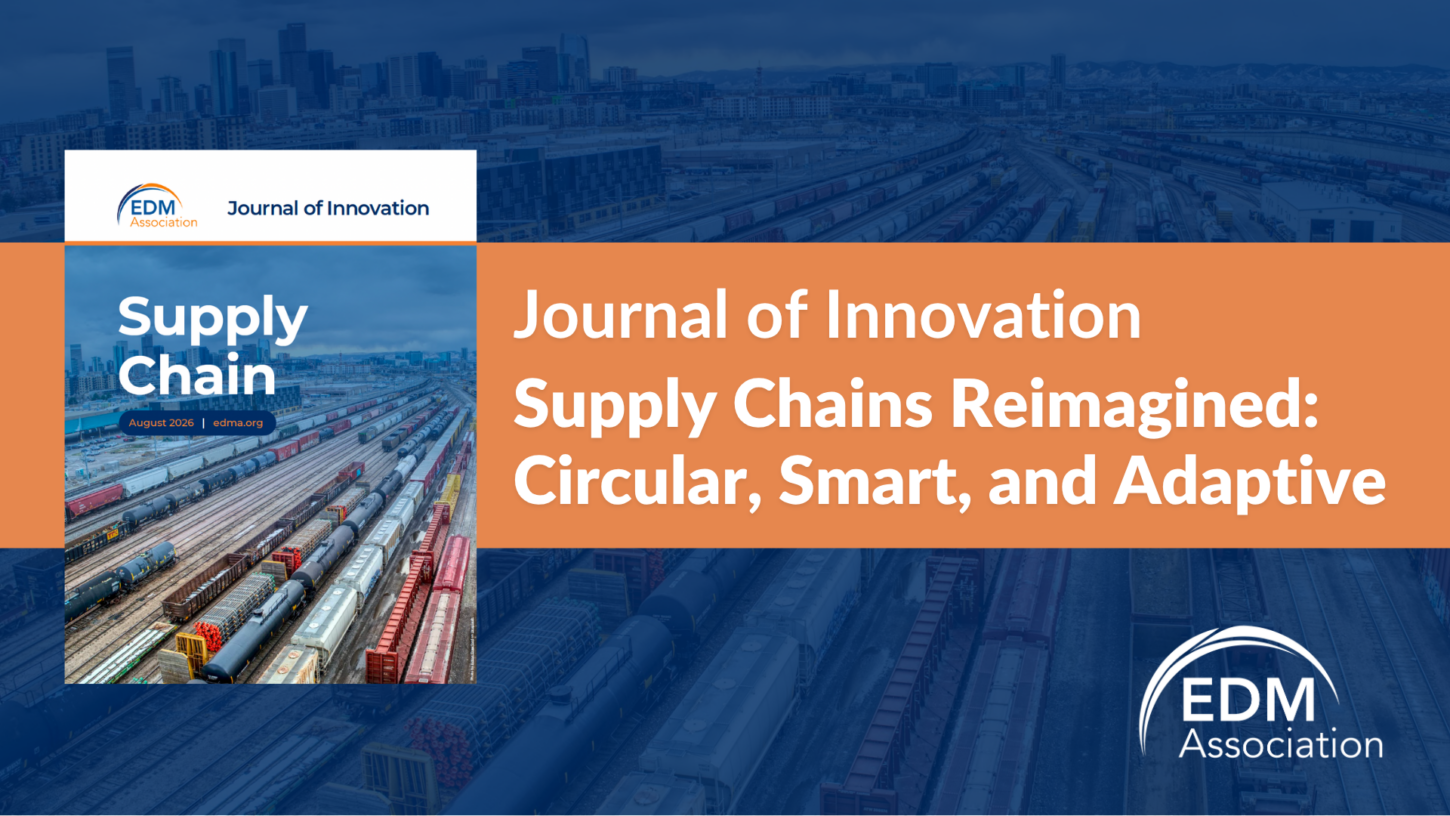
BOSTON, MA – August 28, 2026EDM Association, the global trade association for data management and technology standards, released The Journal of Innovation (JoI) August 2026 edition. The edition is titled Supply Chains Reimagined: Circular, Smart, and Adaptive, and features cutting-edge research and practical insights on the technologies, frameworks, and strategies transforming supply chains in an increasingly complex global landscape.

As organizations contend with geopolitical uncertainty, evolving regulations, digital transformation, and growing sustainability demands, supply chain leaders are rethinking traditional models to build greater resilience, visibility, and agility. This special edition brings together diverse contributions from industry experts, researchers, and practitioners who are advancing innovative approaches to supply chain design and management.

“Supply chains are no longer viewed simply as operational functions; they have become strategic assets that enable resilience, sustainability, and growth,” said Bassam Zarkout, Co-Chair of the Journal of Innovation. “This edition highlights emerging technologies and proven approaches that can help organizations navigate disruption while creating long-term value.”

The issue examines how organizations can respond to fluctuating regulatory, economic, and cross-jurisdictional conditions by embedding flexibility, transparency, and intelligence into their supply chain operations.

Featured articles include:

  • Digital Product Passports for Circular Supply Chains (ARTECH International & BeyondBarCode)
  • Regulatory Digital Product Passports as a Catalyst for U.S. Supply Chain Visibility: Implications of the EU ESPR and UN Transparency Protocol (MITRE Corporation)
  • Financial Supply Chain: The Importance of Data Management for the Payments Industry (EDM Association)
  • Evolvable Multi Agent Hierarchical Architecture for Contested Logistics Ecosystems (Leidos/University of Nottingham)
  • Demystifying Supply Chain Risk Assessment: The MITRE System of Trust™ Framework as a Foundation for AI Governance, Digital Twin Enablement, and Regulatory Compliance (MITRE Corporation)
  • Automated Negotiation for Next Generation Supply Chain Management Solutions (NEC Corporation)
  • Artificial Intelligence in Collaborative Data Sharing for Intra-Company Logistics: Track and Trace, Analytics, and Scalable Ecosystem Value (Ferdinand-Steinbeis-Institut)

“From digital product passports and AI-driven collaboration to supply chain risk management and automated negotiation, the contributions in this issue demonstrate how innovation is enabling more transparent, adaptive, and sustainable supply networks,” said Edy Liongosari, Co-Chair of the Journal of Innovation. “The insights shared by our authors provide both strategic direction and practical lessons for organizations seeking to modernize their supply chain ecosystems.”

The August 2026 edition was peer reviewed by Robert Martin (MITRE Corporation) and Journal of Innovation Co-Chairs Bassam Zarkout and Edy Liongosari. Read the August 2026 edition of the Journal of Innovation.

About the Journal of Innovation

The Journal of Innovation is an EDM Association peer-reviewed publication that brings together thought leaders, researchers, and practitioners to explore emerging technologies, standards, and business innovations that drive digital transformation and industry advancement.

About EDM Association

EDM Association is the only global trade association connecting the data, software, systems, and standards disciplines to accelerate industry innovation and our members’ business success. The Association provides a neutral forum for developing and implementing best practices, frameworks, standards and comprehensive training programs to advance data management, AI optimization, digital twins, augmented reality and more. Today, our membership community—comprising over 700 organizations from the Americas, EMEA and Asia, and over 30,000 professionals—collaborates to build trust and confidence in the data that powers their AI, digital transformation, innovation, regulatory initiatives and business goals. Join the data driven. Learn more at https://edma.org.

Media Contacts:

EDM Association
Karen Quatromoni
Director of Public Relations
Karen@omg.org

Steven Wright-Mark
stevenwm@paragonpr.com


[BLOG] One copy of the truth – Sir Tim Berners-Lee on Solid and the future of enterprise data

In partnership with the Open Data Institute and Inrupt Inc., the EDM Association hosted a webinar titled One copy of the truth – Sir Tim Berners-Lee on Solid and the future of enterprise data. This article summarizes the discussion from the webinar itself, and also provides additional information about the Solid protocol and the launch of a collaborative Community of Practice. 

Webinar Live Date: July 14, 2026

Speakers:

  • Sir Tim Berners-Lee, Inventor of the World Wide Web, Co-founder/CTO, Inrupt Inc. and Co-founder, Open Data Institute
  • John Bruce, Co-founder and CEO, Inrupt Inc.
  • Jesse Wright, Project Lead – Solid, Open Data Institute
  • Elisa Kendall, Senior Ontologist, EDM Association
  • Jim Halcomb, Chief Research & Development Officer, EDM Association
  • Moderator: Emma Thwaites, Strategic Advisor, Global Policy and Corporate Affairs, Open Data Institute

Solid and the EDM Association Solid Community of Practice

Solid is a privacy-by-design protocol, built on standard web technology that aims to bring agency and interoperability to how data is used. Rather than each application holding its own copy of a person’s or organisation’s data, Solid stores it in a Pod: an online data store with fine grained access control linked to the person or organisation in question, rather than the specific app they’re using. Because Pods use open, linked-data standards, the same data can be reused across organisations without bespoke integration, and stays under the control of the person or entity it describes. Solid was developed by Sir Tim Berners-Lee‘s lab at MIT, nurtured by a global community, and is incubated through the W3C Solid Community Group and standardised by the Linked Web Storage Working Group.

The Open Data Institute (ODI) became Solid‘s steward in October 2024, bringing more than a decade of experience in responsible data innovation. Its stewardship ensures the infrastructure develops to benefit society, with governance that reflects community values and standards that enable global interoperability. The ODI maintains Solid’s open-source foundations, is supporting the standardisation of parts of Solid technology in the Linked Web Storage group, and catalyses use-case pilots that demonstrate real impact. 

This webinar marked an exciting next step for Solid and the ODI: partnering with the EDM Association to convene a Community of Practice around the standard. The group is aimed at making Solid ready for real-world use in finance, healthcare and government, with conformance anchored to Cloud Data Management Capabilities (CDMC) and sector mappings built on assets such as the Financial Industry Business Ontology (FIBO). More information on the community, and how you or your organisation can join can be found at the bottom of this message!

The Webinar in Brief

This webinar explored the origins and evolution of Solid, an open standard designed to give individuals greater control over their personal data while enabling organisations to build applications using a shared, interoperable data architecture. It reflected on how the web has evolved from an open, collaborative environment into one characterised by data silos and centralised platforms, positioning Solid as an alternative approach that allows individuals to control how their data is accessed and used.

The conversation also examined the relationship between Solid and AI, explaining how AI agents can access only the information an individual has granted permission to use rather than relying on centralised copies of personal data. The speakers also discussed how this model can help organisations build customer-facing AI applications while addressing challenges around data access and permissions across multiple systems.

During the Q&A, the discussion covered topics including data ownership, verifiable credentials, permission-based access, and the practical steps organisations can take to begin piloting Solid through an initial use case. The session concluded by noting that growing interest in AI is creating new opportunities for organisations to explore Solid as a foundation for data access and AI-enabled applications.

View the webinar presentation

Q&A: Read all the responses

Join the Solid Community of Practice: Your gateway to the future of enterprise data

If you or your organisation would like to learn more about Solid, and be part of this work, the community of practice is open to new members! We encourage you to join the Solid Forum via EDMConnect and help shape the future of enterprise data management. 

Forum meetings begin on September 10, 2026, and full meeting information is available on the EDMConnect Solid Forum.

Join the Solid Forum

Data Driven: EDM Association’s Q3 2026 Update

From John Bottega, President, EDM Association

Dear Members, Partners and Friends,

As we move through 2026, I want to share an update on where the EDM Association is focusing its energy on your behalf, and the activities underway to keep our global community – across our Data & Analytics, OMG Standards, Digital Twin Consortium and Augmented Reality (AREA) groups – at the leading edge of data management, digital engineering and standards. Our work continues to center on the practical, business-critical challenges our members face — and on building the shared infrastructure that makes good data management and innovation possible across the industry.

Business Environment

EDMA is balancing growth and innovation with disciplined stewardship as members navigate AI-driven change and economic uncertainty.

We are mindful that our  work with all of you is happening against a backdrop of real challenge and real opportunity. The rapid advance of AI is reshaping what our members need from data management, digital engineering and standards, even as it unfolds amid an uncertain economic and global environment. We recognize that many of our members, and the broader marketplace, are navigating funding constraints and closer scrutiny of travel and discretionary spend. With that context firmly in mind, we are working to make sound, disciplined business decisions that position the Association for sustainable growth — investing where it matters most to members and being deliberate stewards of the resources you entrust to us.

Upcoming 2026 Member Events

Members can look forward to an active schedule of global technical meetings and networking opportunities through the remainder of 2026

Q3 & Q4 will be very busy for EDMA in-person events  across the globe, including the US, UK, Australia and India. Please check out the Conference and Events information for our DataVision events; Q3 Object Management Group (OMG) and Business Architecture in Data Management events in Orlando and Digital Twin Consortium (DTC) member meeting in Leeds, UK; annual charity golf event in New Jersey, US; as well as several industry conferences. We hope that you can join some or all to network with the EDMA community!

Register to join these events, and please get in touch to explore speaking or sponsoring opportunities.

PLUS, stay tuned for updates to be announced about our Q4 OMG Technical Meeting and DTC Member Meeting! Both will be held IN PERSON in the US in early December. More to come soon!

EDM Association’s Dynamic Market Position

We are actively positioning EDMA as the leading advocate for trusted, standards-based data foundations that enable successful AI adoption

Our members, and the global marketplace, across all industries and geographies are dealing with navigating the opportunity and challenge of adopting and leveraging AI across the enterprise. They are looking for guidance, collaboration and innovation to build their operational and business strategies.

The EDM Association’s position is clear: the path to AI optimization begins with trusted, interoperable data through best practices and standards. As AI systems scale, organizations are learning that performance depends not just on models, but on the quality, structure, and shared meaning of the data beneath them. Ontologies, knowledge graphs, and standardized data products transform fragmented information into machine‑readable intelligence, shifting the paradigm from “garbage in, garbage out” to “gold in, gold out.” This foundation is what enables AI to reason accurately, digital twins to mirror reality with fidelity, and AR systems to deliver contextual intelligence in real time. AI is leading to the convergence of innovative technologies, trusted data interoperability, standards and best practices. The EDM Association is well positioned for this convergence and the future is bright.

Business Update

Across industries and geographies, EDMA is advancing strategic initiatives focused on AI, interoperability, emerging technologies, and business value

Within and across the EDM Association, we are working with our member communities to undertake and advance significant conversations and initiatives – all focused around business impact and AI.  Here are just a few of many recent highlights:

  • Agentic AI & Data Products framework for global financial services firms
  • Building on FIBO (Financial Industry Business Ontology) & other open ontology frameworks
  • Driving XR frameworks to enable business value
  • Adding Space Systems to the Aerospace and Defense working group
  • New quantum computing working group in the DTC
  • Joining the AMD’s Open Robotics Partner Ecosystem
  • Partnering with Isle of Man on the first-of-its-kind legislated Data Monetization structure (see the Data Asset Foundations initiative)

Highlights From Our Consortia

Object Management Group (OMG Standards Development Organization)

OMG continues to expand the standards and frameworks that enable scalable, interoperable, and trustworthy enterprise AI solutions

Our OMG team continues to push the boundaries of what’s possible in AI by strengthening the standards that make real interoperability achievable. They’re evolving the knowledge‑representation foundations — from API4KP and ODM to OMG Commons and our own FIBO ontology — that today’s agentic AI systems rely on. At the same time, they’re tackling the emerging challenges organizations face as they move from experimentation to enterprise deployment, with new work supporting GenAI, Graph‑RAG, and other fast‑moving technologies. The focus is squarely on practical adoption: building the frameworks, like SACM and SysML v2, that help organizations deploy AI responsibly, at scale, and with confidence.

Augmented Reality for Enterprise Alliance (AREA)

AREA is helping organizations translate XR technologies into measurable operational and workforce benefits.

AREA continues to be a powerful force in helping organizations turn XR (extended reality) from a promising idea into a proven business capability. Our Innovation Impact Framework keeps the emphasis on human‑centered design and workforce adoption — the real keys to avoiding stalled pilots and achieving measurable value. Recent webinars have showcased how companies are using XR to improve productivity, quality, safety, and training, including smart ways to convert legacy content into AR‑ready data. With active participation across major industry events and a growing community of members, the AREA is expanding collaboration opportunities and strengthening the enterprise XR ecosystem. Their research, tools, and frameworks are helping organizations navigate the strategic, technical, financial, legal, and workforce considerations that come with adopting AR at scale.

Digital Twin Consortium (DTC)

DTC is accelerating digital twin innovation through interoperability, physical AI, robotics, and industry-focused collaboration.

The DTC continues to accelerate innovation in digital twins, moving the field from prediction to action through physical AI, interoperability, and real‑world deployment. Our collaboration with AMD’s Open Robotics Partner Ecosystem is helping advance robotics and automation, while webinars and workshops highlight successful digital twin applications across energy, manufacturing, robotics, and space. The ecosystem keeps expanding, with new members and leadership — including Entarian joining the Steering Committee — bringing fresh expertise from aerospace, defense, healthcare, manufacturing, and research institutions. DTC’s recent programs, from the Space Mission Systems Workshop to Front‑Running Simulation initiatives and new working groups like Quantum, demonstrate how digital twins are delivering operational decision‑making and business value in complex, data‑intensive environments.

Data & Analytics Initiatives

EDMA is expanding practical guidance, standards, and tools that help organizations build trusted, AI-ready data ecosystems

Across EDMA, we’re seeing members push hard to make AI dependable, governed, and grounded in trustworthy data. Our expanded work on AI‑ready data is helping organizations structure, validate, and manage the information that fuels AI and machine‑learning models — including using AI itself to accelerate tasks like classification, lineage discovery, and quality remediation. At the same time, we’re deepening our guidance on data products, giving members practical patterns and operating models for designing discoverable, well‑owned, high‑quality data assets that agentic AI can rely on. FIBO continues to anchor our ontology standards work as the shared semantic foundation for financial services, with ongoing improvements in coverage, tooling, and adoption. And through the Data Asset Foundations, we’re helping members turn well‑governed data into measurable business value by giving them a structured way to inventory, assess, and manage data as a true enterprise asset. Together, these efforts support the shift from experimentation to repeatable, enterprise‑ready data and AI practices.

Key Partnerships

Strategic partnerships are broadening the Association’s influence and strengthening alignment across data, engineering, and standards communities

None of this work happens in isolation, and we continue to invest in partnerships that extend the reach and rigor of our standards and practices:

  • INCOSE — collaborating on the intersection of systems engineering and data/information management, so data considerations are built into complex systems from the start.
  • OGC (Open Geospatial Consortium) — aligning geospatial and location data standards, supporting members whose data assets increasingly carry a spatial dimension.
  • ODI (Open Data Institute) — partnering on open data practices, data trust frameworks, and broader data ecosystem thinking that complements our members’ enterprise-focused work.

Together, these partnerships help ensure that the standards and practices we develop stay connected to the wider data, systems, and standards communities — and that our members benefit from perspectives beyond any single industry or discipline.

Training and Certification

New training and certification programs are equipping members with the skills needed for next-generation data, AI, and systems initiatives

We remain committed to expanding our training and certification offerings so members can build and validate the skills these initiatives demand. Highlights of our growing curriculum include:

  • SysML v2 — training on the next generation of the Systems Modeling Language, helping members apply rigorous, model-based approaches to complex data and systems design.
  • DCAM 3 — the newest release of our Data Management Capability Assessment Model certification, giving members an updated benchmark for assessing and maturing enterprise data management practices.
  • AI Optimization Masterclass — an in-depth, practical workshop to deepen expertise in applying AI within a governed, data-driven enterprise.

These offerings reflect our ongoing investment in professional development, and we encourage members to take advantage of them as they roll out.

Operations

Internal modernization efforts are improving the efficiency, reliability, and member experience of the Association.

Behind these program initiatives, we are also investing in the operational foundation that supports them. We are working to normalize and improve our technology environment, streamline internal processes, and strengthen how we communicate and engage with members. This includes modernizing the systems and workflows the Association relies on day-to-day, so that member-facing services are more reliable and consistent, and improving the channels and cadence through which we keep members informed and involved. Our aim is an Association that runs as efficiently and transparently as the standards and practices we promote to the industry.

Get Involved

Members are encouraged to actively participate in working groups, standards development, partnerships, and community initiatives

Each of these initiatives depends on active member participation. If you would like to join a working group, contribute to FIBO development, pilot the Data Asset Foundation, or get involved in any of our partnership activities, please reach out to your member relationship contact, email our Member Services team, or get in touch through our online contact page. We welcome your engagement and your expertise!

In Closing…

On behalf of the EDM Association, we remain grateful for your continued membership, support and commitment to advancing our data-driven, innovative future – cross-industry and around the globe.  We look forward to advancing this work together.

Digital Twin Consortium Announces the Digital Twin System Framework

Defining the four-layer architecture that turns digital twin insight into operational action

BOSTON, MA – AUGUST 25, 2026 – The Digital Twin Consortium® (DTC™), an EDM Association community, today announced the Digital Twin System Framework, formally defining the Digital Twin System (DTS) – a term already present in DTC’s published digital twin definition but never separately defined. The framework specifies the DTS as a four-layer architecture – Data, Context, Decision and Process Orchestration, and Actuation – supported by the Digital Thread, and extends DTC’s decision-making language so that humans, autonomous agents, and robots are treated as actuators.

A digital twin shows what is happening in a physical system; the Digital Twin System defines how that insight becomes action – and each layer adds distinct value. Data is the foundation: synchronized, trustworthy information drawn from the physical system. Context gives that data meaning, binding it to the asset, its process, and its operating limits. Decision and Process Orchestration turns meaning into evaluated, coordinated decisions. Actuation closes the loop, carrying decisions back into the physical world through people, autonomous agents, or machines.

“The Digital Twin System Framework unifies DTC’s prior work – the Digital Twin and AI Agent Capabilities Periodic Tables, the Industrial AI Agent Manifesto, and the Digital Thread – into one cohesive architectural framework, each defined a piece of the problem. The DTS defines how they operate together, giving organizations a single blueprint to realize digital twin systems in production,” stated Dan Isaacs, GM & CTO, DTC.

Consider a pump in a water treatment plant. The Data layer streams vibration and flow measurements; the Context layer maps them to the pump’s model and operating envelope, revealing early-stage cavitation; Decision and Process Orchestration weighs the evidence, confirms who – or what – has authority to act, and selects the response; Actuation executes it: a maintenance work order, an AI agent rescheduling downstream operations, or the control system trimming pump speed. The Digital Thread preserves traceability from measurement to action.

“AI has moved faster than the architectures many companies use to govern it,” said Pieter van Schalkwyk, CEO of XMPro and Co-Chair of the Composability Framework Working Group. “The Digital Twin System gives industrial organizations a way to connect AI to operational reality without losing control of context, evidence, authority or safety.”

At scale, the Decision and Process Orchestration layer is multi-agent: specialized AI agents coordinate under clear safety hierarchies rather than communicating point-to-point, preventing conflicting objectives from creating unsafe system states. For trustworthy production deployment of the Actuation layer, the framework leverages the ten governance laws of the DTC’s previously announced Industrial AI Agent Manifesto, developed by the Composability Framework Working Group.

The laws – including deterministic validation and execution, separation of agent cognition from action execution, emergency stop and human override, complete auditability, and multi-agent safety orchestration – ensure that every action reaching the physical world is validated against the digital twin’s constraints, traceable, and subject to human override.

The framework extends the Digital Twin Capabilities Periodic Table and the AI Agent Capabilities Periodic Table, which maps onto the four layers, and support digital engineering methodologies. The Digital Twin System shows how digital twin information can participate in a broader operational architecture for decisions, orchestration, and actuation.

Learn more about the DTS Framework. Watch the upcoming Webinar on September 9th at 1 pm PT. Led by DTC member co-chairs of the Capabilities and Technology and Digital Engineering: Pieter Van Shalkwyk, CEO of XMPro and Dr. David McKee, CTO of Crysp, the webinar showcases real-world deployed application examples.

About Digital Twin Consortium
The Digital Twin Consortium® (DTC) is Accelerating Digital Twin Innovation™. DTC advances digital twin adoption and market growth by working closely with members to foster development, raise awareness, and enhance interoperability of digital twin applications throughout the Digital Twin Lifecycle across industries. DTC is an EDM Association community. For more information, visit https://www.digitaltwinconsortium.org.

Note to editors: All trademarks are the property of their respective owners.

Media Contact:
Karen Quatromoni
Karen@omg.org

Welcome Competition and Markets Authority as EDM Association’s newest member

The UK Competition and Markets Authority (CMA) is an independent government body responsible for promoting competition, protecting consumers, and investigating anti-competitive practices, mergers, and market issues across the UK.

Learn more here.

Eyes on Data: The AI Readiness Gap — Why Data Strategy Is Now a CEO-Level Issue

By EDM Association

Published on TDAN.com

Across industries, CEOs and executive teams are asking how AI can improve productivity, reduce costs, strengthen decision-making, and create new sources of competitive advantage. Organizations are making significant investments in AI platforms, infrastructure, and talent while accelerating efforts to move from experimentation to enterprise-wide adoption.

But a critical question is often missing from the conversation:

Is the organization actually ready to scale AI?

The 2026 EDM Association Global Data Management Benchmark Report suggests that, for many organizations, the answer is not yet.

Based on responses from more than 435 organizations across more than 50 countries, the report reveals a widening gap between enterprise AI ambition and the organizational foundations required to support it. While AI adoption is accelerating, many companies continue to struggle with strategy, accountability, funding, governance, architecture, and workforce readiness.

The implication for CEOs is straightforward: AI readiness is an enterprise data management question.

Read the full article on TDAN.com

JPMorgan Chase is the EDM Association’s Newest Member

JPMorgan Chase is a leading global financial services firm providing investment banking, commercial banking, asset management, consumer banking, and wealth management services to individuals, businesses, institutions, and governments worldwide.

For more information, click here.