


Details
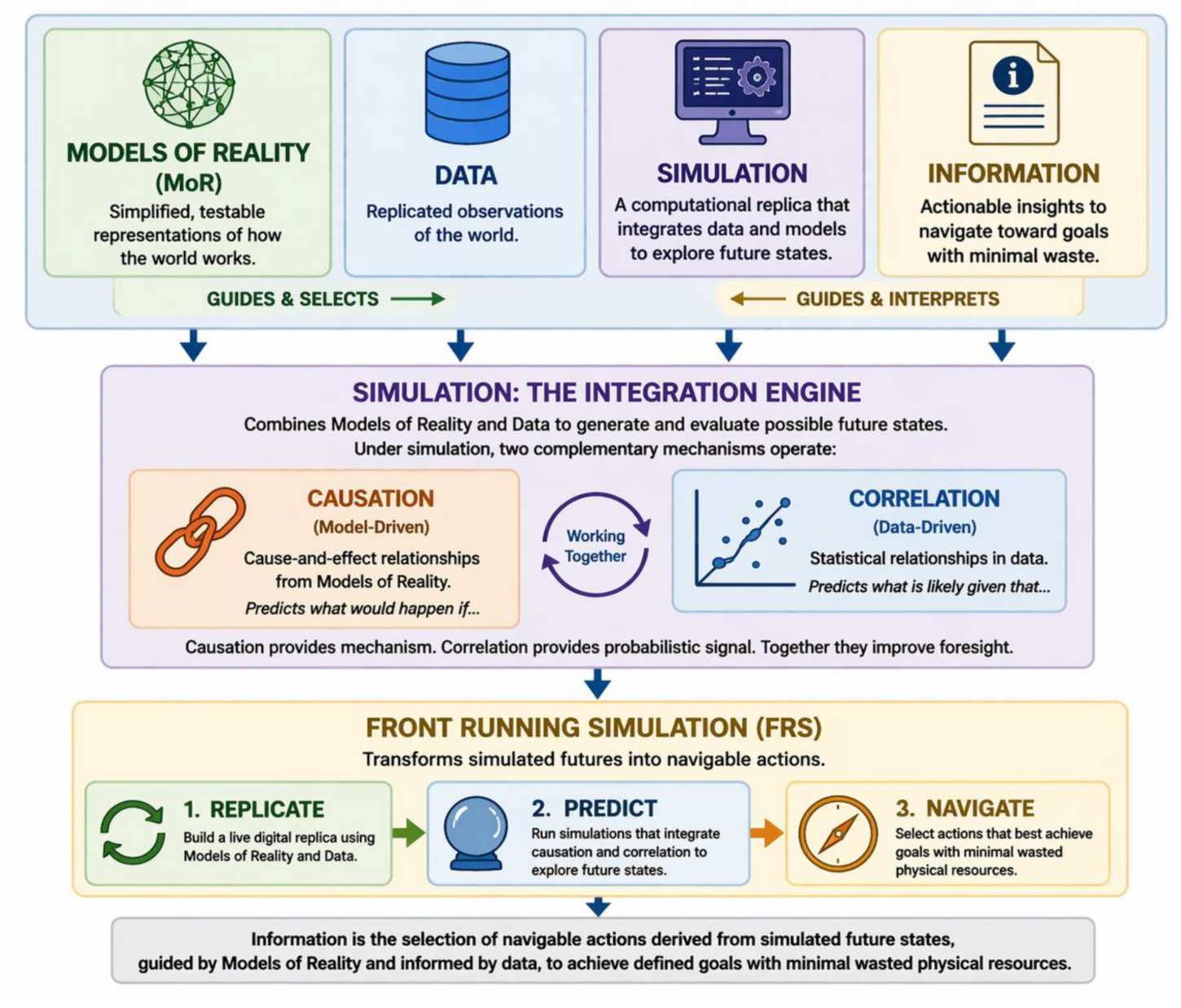
A prediction you cannot act on has no operational value. Front-Running Simulation (FRS) is a digital twin framework introduced by Dr. Michael Grieves that continuously synchronizes with a live system, predicts probable futures using simulation and AI, and identifies the navigable information actions that move the system toward its goal with minimal wasted time, energy, and material. Dr. Grieves presents the framework and Pieter van Schalkwyk, CEO of XMPro, demonstrates a working implementation on a hydrocarbon processing plant, running a single candidate setpoint change end to end — from simulated future to guarded, auditable action.
Dr. Grieves’ paper, Front Running Simulation: A Digital Twin Framework for Real-Time Replication, Prediction, and Goal Navigation, frames a shift from reacting to operational anomalies to proactively navigating toward operational goals. At its center is the Simulation Integration Engine, which fuses two complementary mechanisms: causation, supplied by physics-based models of reality, and correlation, supplied by observed current and historical data — a fusion, not a competition. The demonstration walks one action, raising reboiler duty to hold propane purity as the feed turns heavier, through the full loop: physics-based prediction, an explicit structural causal model, a data-anchored surrogate with a model-fit check, a deterministic safety guardian, and a confidence tier that determines whether the system acts autonomously, recommends to an operator, or holds.
Attendees will be able to learn about the FRS framework and the added value this provides to a Digital Twin. Using the FRS framework, attendees will understand how to evaluate whether their own digital twin architecture can close the loop from prediction to safe and effective execution, and to apply FRS’s causation-correlation fusion, safety gating, and confidence tiers to continuous and discrete process use cases in their organizations.
Learn more about Digital Twins
Speakers